The Context of the Nuclear Threat in US-Iran War
The Mohamad Safa resignation is a claimed leak of the nuclear threat in US-Iran war. Mohamad Safa resignation also claims to expose the higher level corruption in the United Nations (UN). However, I am not discussing this claim in the current blogpost. Here-in-below, I am only discussing the scope of international law intervention in the context of the nuclear threat in US-Iran war while assuming the claimed leak vide the Mohamad Safa resignation is credible enough to form the basis of this blogpost.
United Nations and the Nuclear Threat in US-Iran War
The UN is an assembly of nations, which was formed, replacing the League of Nations, precisely to obviate war. It acts in the matters of war and aggression mainly through its body called United Nations Security Council (UNSC). The UNSC has enough authority (and also power through the P-5 nations) to intervene and forcibly check aggression and war. However, it is restrained by its composition.
The five nuclear states; i.e., the US, Russia, China, the UK, and France; can veto any majority decision of the UNSC. It is indeed a very crude deliberation mechanism. Furthermore, it is directed towards blocking rather than reaching a decision. In the present UNSC, the western bloc comprising the US, the UK, and France are apparently on the same side; and Russia and China, on the other side. Trump’s Gaza Peace Plan Resolution did pass because China and Russia abstained instead of vetoing it.
However, Trump’s Gaza Peace Plan Resolution, S/RES/2803 (2025), had nothing beneficial. The passing of that resolution is rather indicative of the larger trend of abdication of responsibility in the UN. I have proposed a better UN endorsed peace plan in Gaza Peace Plan: The Need for A Better UN Endorsed Proposal. The fact that the UN, instead of taking an active role in Gaza peace process, submitted to the arbitrariness of Trump’s Gaza Peace Plan Resolution, shows that the law in the UN is handmaiden of the politics of the nations.
Anyways, a subtle attempt to raise the US-Israel aggression on Iran has already been made in the UNSC vide Resolution S/2026/159 proposed by Russia and China. However, the resolution didn’t directly blame the US and Israel for aggression. Nevertheless, it was defeated by the veto of the US. On the other hand, the Resolution S/RES/2817 (2026) proposed by the GCC directly blaming Iran for attack on territorial integrity of the GCC nations was adopted, for Russia and China abstained instead of vetoing it, in a fashion similar to Trump’s Gaza Peace Plan Resolution.
The fate of the above three resolutions is indicative of the current geopolitics. Russia and China have transactional relationship with Iran. However, they are not enemies of Israel and the GCC and are definitely not inclined to offer unconditional diplomatic or legal support to Iran against the US, Israel and the GCC, leave aside the unconditional military support. I am not inclined to accept such geopolitical deliberations as any kind of law. In my understanding, the international law qua the UN/UNSC just doesn’t exist in reference to the nuclear threat in US-Iran war.
However, international law is not really forbidden. Next I try deciphering its application in the nuclear threat in US-Iran war through the International Criminal Court (ICC) and the International Criminal Police Organisation (INTERPOL).
The ICC/INTERPOL and the Nuclear Threat in US-Iran War
The ICC is governed by the Rome Statute. Vide article 4 of the statute, the ICC has been setup as an international legal personality with adequate capacity to act as a criminal court. It is well-settled that a criminal court while taking cognizance of a crime has implied powers to prevent the commision of the same crime in the future. The ICC, obviously, has such implied powers too. Vide article 5, the subject matter jurisdiction of the ICC is restricted only to four categories of serious crimes of international concern: the crime of genocide, crimes against humanity, war crimes, and the crime of aggression.
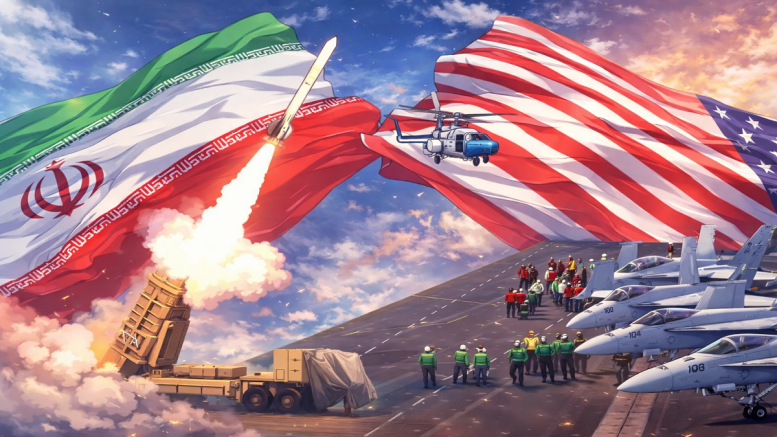
The US and Israel have been repeatedly attacking nuclear facilities in Iran. In Operation Midnight Hammer, they attacked Fordo Fuel Enrichment Plant, Natanz Uranium Enrichment Plant, and Isfahan Nuclear Technology Center. In Operation Epic Fury, they have attacked Khondab Heavy Water Complex and Ardakan Uranium Processing Plant along with Fordo and Natanz. Iran has also attacked Dimona (Negev Nuclear Research Center) in Israel. Both the US and Israel also possess nuclear weapons. Trump has also issued threats of converting Iran into stone age. All the above are indeed already committed crimes vide the subect matter jurisdiction of the ICC.
However, there is a catch. Vide article 12, the ICC can act only if the crimes are either committed on a state who is a member of the ICC or by the national/s of a state who is a member of the ICC. Neither the US, Israel, nor Iran are the members of the ICC. The ICC can also exercise jurisdiction if the concerned state makes a declaration accepting the jurisdiction of the ICC with respect to the crimes in question. None of the three states is, however, expected to make any such declaration.
The ICC can exercise jurisdiction on non-members only if the reference has been made by the UNSC. I have already discussed the non-existence of international law in reference to the UNSC above.
However, here the issue is that nuclear threat is not restrained by national boundaries. The effect of severe nuclear attack on Iran faclities can range upto Western India, and that on Israel can range upto Cyprus. All nations within would be sufferers. So, US-Israel, by attacking Iranian facilities, and Iran, by attacking Israeli facilities, are committing crimes against all the states between Cyprus and Western India. Most of these states also are not members of the ICC, but a few are: Jordan, Afganistan, Palestine. Vide article 14, any of these three states can make a reference to the prosecutor of the ICC. Though I doubt if they will do the needful.
However, vide article 15, the prosecutor can initiate investigation proprio motu (of his own accord) on the basis of the information of commission of crimes received by him. The source of his information can be anything. It can even be a petition by an individual. The information can be submitted through this link (I intend to use it in the due course). The process is long-winded, but it is deemed to be non-political and a proper procedure under international law. The only question is whether the ICC would intrepret its jurisdiction and the crimes mentioned in article 5 in such a way as to lodge an investigation and prosecution thereof.
If the ICC does exercise its jurisdiction, which it should, it should issue arrest warrants against accused persons to prevent commission of further crimes of the same or more severe nature. There is enough precedent for this vide the Gadaffi case (para 91 to 93). Or it could also issue directions to prevent such crimes. The power of the ICC are unbridled vide article 4 of the statute as discussed above.
However, there is still the question of execution of the ICC orders. It is naive to believe that the police authorities of any of the three states will execute the orders of the ICC presumably against their heads of state and/or senior officals. Therefore, INTERPOL comes into picture. The ICC and INTERPOL have a co-operation agreement. The apparent function of INTERPOL is to issue notices. However, the provisioned authority and function of INTERPOL is much wider, and thankfully there is no veto in INTERPOL.
Most notably, article 11 of INTERPOL’s constitution gives power to the general assembly of INTERPOL to form special committees for dealing with particular matters. Such a committee can indeed be set up to execute any directions of or warrants issued by the ICC. Though INTERPOL’s constitution vide article 3 prohibits it from intervening in or taking action of political nature. There is a precedent, once again in the Gadaffi case, where the directions of the ICC were framed as legal acts rooted in the co-operation agreement. The terms of the co-operation agreement are indeed sufficient to ensure the execution of the ICC’s directions or warrants through INTERPOL and thus intervene in the nuclear threat in US-Iran war.
Conclusion
The nuclear threat in US-Iran war is real. Politics will not obviate it. Law is too important to operate under the shadows of geopolitics. The above blogpost is an attempt, albeit weird, to find space for more powerful existence of law. Nothing more, nothing less!

Be the first to comment on "Nuclear Threat in US-Iran War: Is International Law Really Forbidden?"